Quick wins

High-impact workflows identified and prioritized for fast returns.

Blueprint builds a picture of how work runs today. The apps people use, how they’re used, and the role drift, exceptions and workarounds that never make it into documentation.
Not every activity should be automated. Blueprint identifies what to agentify, what to augment, and what to keep human, helping you define your target state before you invest.
With current and target state defined, Blueprint maps the path between them: which interventions come first, where to bring in deeper Process Intelligence, and when to deploy Agents.
Blueprint sets a baseline before anything changes and puts a dollar figure on every recommendation, so you can model the value up front, then track ROI as it lands.
The Nature of Work framework classifies every activity by one question: What does the work produce? From there, you decide what becomes an agent, and what stays with people.
Execution
Rule-based work that follows a defined path. The kind of work that can often be automated.
Comprehension
Reading, reviewing and interpreting information. Turning inputs into understanding.
Creation
Producing new outputs. Drafting, building and generating work that didn’t exist before.
Decision
Making judgment calls where the answer isn’t obvious. Balancing context, risk and trade-offs.
Communication
Sharing information, coordinating activity and aligning people across teams.
Repeatable, predictable work that can run autonomously end-to-end.
Structured work where deterministic AI can execute consistently without agent orchestration.
AI handles the workflow while people review, approve or intervene when needed.
People own the work. AI provides context, recommendations and support.
Judgment, expertise and relationship-driven work that remains with people.
Work that can be simplified, consolidated or removed entirely.
Phase 1
High-impact workflows identified and prioritized for fast returns.
Phase 2
Repeatable processes automated at scale across operations.
Phase 3
AI agents deployed into nuanced, exception-heavy workflows.
Phase 4
AI operating models embedded across the business.
Every recommendation is based on your goals, risk tolerance, and AI posture. But the strategy stays firmly in your hands.

Human oversight first. AI assists, humans decide. Tightest guardrails.
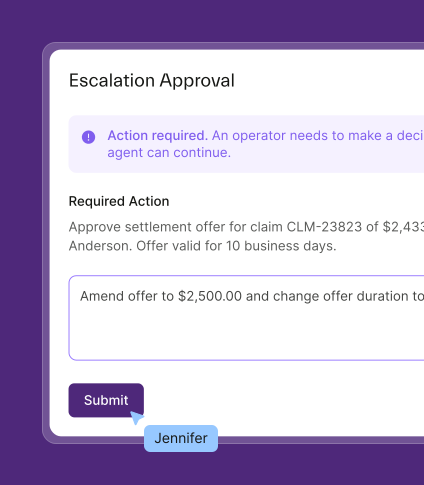
Balanced automation and human judgment. The default for most regulated industries.
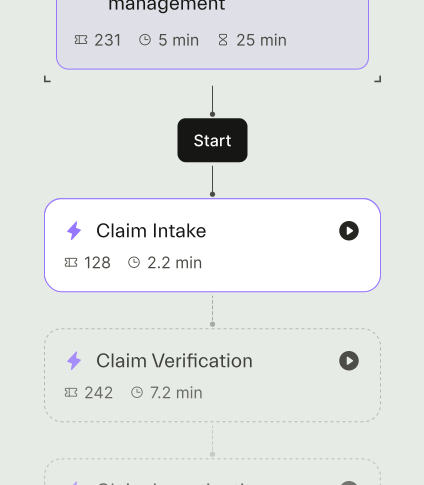
Maximum AI autonomy in scope. Highest capacity recovery. For organizations ready to move fast.
A lightweight sensor captures how work really happens. Every click and app switch across your entire workforce. Millions of signals a day, where traditional methods only ever sample a handful of processes.
An AI blueprint is a structured plan that identifies where AI can create value across an organization, prioritizes opportunities based on business impact, and defines a roadmap for implementation. Effective AI blueprints are grounded in how work gets done, not just organizational charts or process documentation.
Process mining reconstructs processes from system logs: it sees the transactions your software records, but not the work happening around them. Blueprint observes the actual work: the clicks, documents, and decisions across people and applications, including the exceptions and workarounds that never touch a system log. That’s how it surfaces the 60%+ of work that’s invisible to managers, and turns it into an enterprise-wide view of where AI can create value.
A Nature of Work framework categorizes activities based on factors such as repeatability, complexity, judgment, and variability. It helps organizations determine which work can be automated, which should remain human-led, and where AI can provide the greatest value.
AI ROI should be measured against operational and business outcomes, including productivity improvements, cycle time reductions, cost savings, quality improvements, and adoption rates. Leading organizations establish a baseline before deployment and track impact continuously over time.