
14,000+
hours/year of automation-ready effort
Before, it was turn on AI and hope. Now we know exactly which processes to automate, what we'll save, and how to prove we got there.

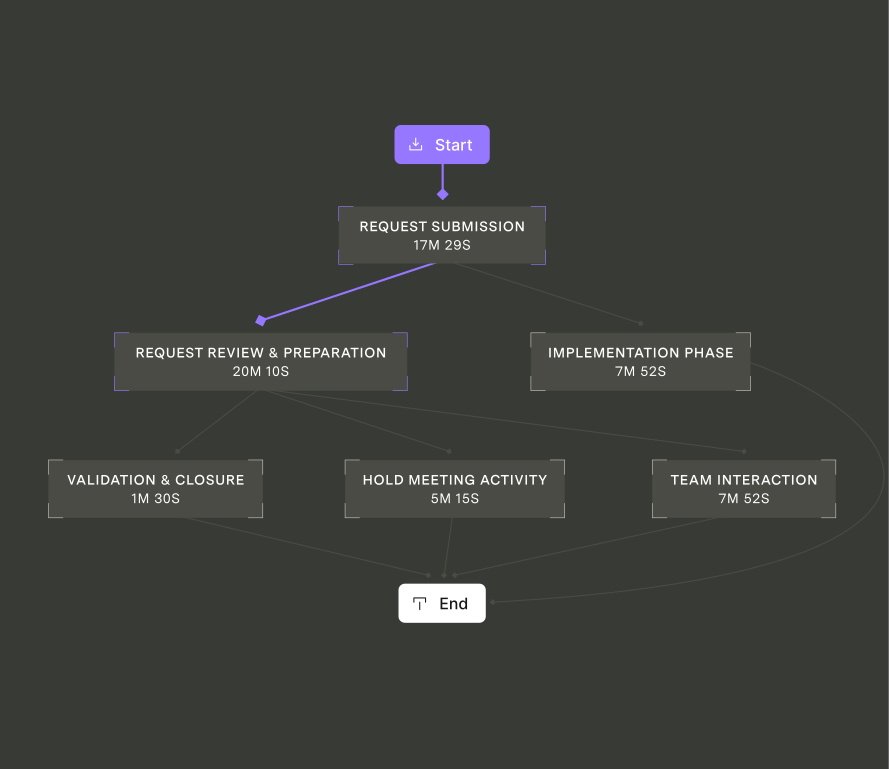
Get a complete view of existing work
Traditional process discovery and system logs show only 20% of work activity. Work observation captures how work gets done, across applications and teams.
Establish baselines for performance
Without standards in place, automation can scale broken processes and technical debt. Establish metrics for performance across all process variants to define success.
Identify high-priority targets for automation
With a complete view of work, identify high-volume tasks ripe for standardization. Then prioritize and execute automation based on projected business impact and ROI.
Optimize tasks and deploy AI agents
Continuously set new baselines for manual and automated work. Use insights to further optimize workflows, create operational context, and deploy AI agents.
Across mainframes, virtual desktops, and web apps, capture real work wherever it happens with zero integration and complete privacy.
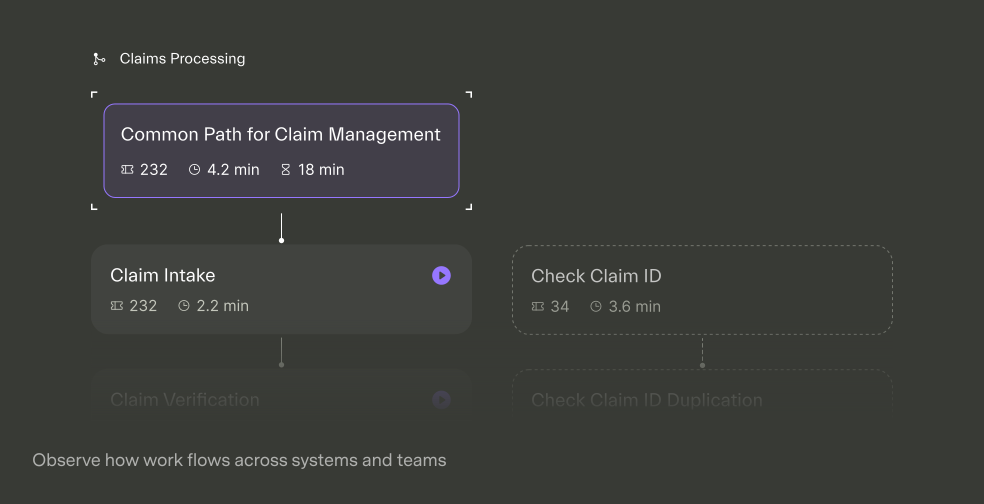
Understand all the process variants across your organization and match every automation opportunity to the best-fit approach.
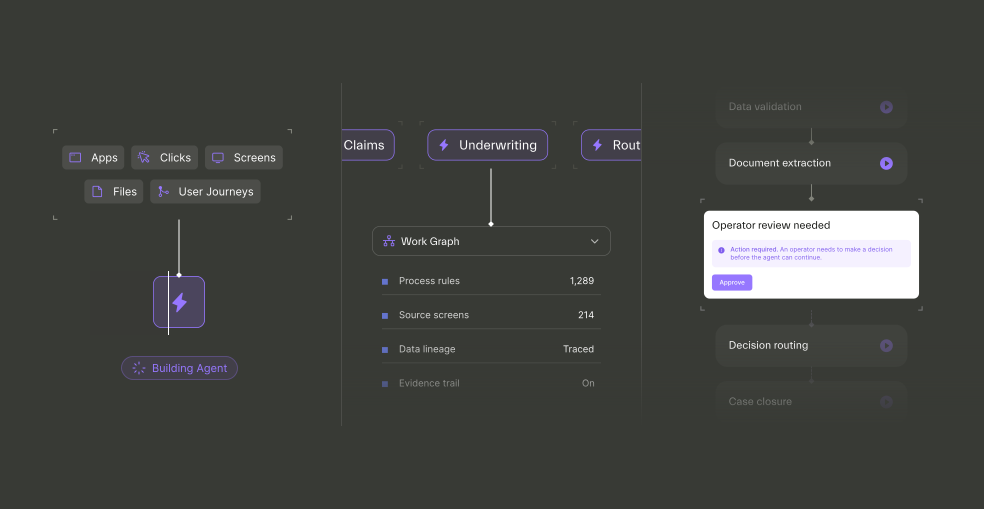
Move from a prioritized automation roadmap to building production-ready AI, with agents trained on observed work.
Average reduction in processing times
Average decrease in manual errors
Average increase in productivity
Automation discovery for AI agents is deciding what to hand to agents based on observed work, not interviews and documentation. Skan AI observes how work actually gets done across mainframes, virtual desktops and web applications, shows where agents can fit, what to prioritize and what it is worth, then builds agents from that observed work.
Process mining reads system event logs, which show only about 20% of work activity, so agents built on it miss the rest. Skan AI observes the actual work, including task switching and handoffs across Excel, email and legacy mainframes, with zero integrations, APIs, or logs, so agents are built on the whole picture.
Skan AI sets performance baselines, then scores every task. Skan AI Blueprint classifies the work, sets your automation posture (conservative, moderate or aggressive) and produces a roadmap with a dollar value on each opportunity. Skan AI Intelligence scores task complexity and recommends whether to agentify, augment or keep each task human.
Skan AI builds agents from observed work, so they run on how work actually happens. Once agents are live, Skan AI Agents track KPIs before and after automation and continuously rescore opportunities, so the roadmap stays current.
Skan AI customers see an average 37% reduction in processing times, a 20% decrease in manual errors and a 26% increase in productivity. At Definiti, Skan AI identified more than 14,000 hours a year of automation-ready effort, and Skan AI Agents track KPIs before and after automation to show the results.
Most engagements deliver dollar-quantified opportunities for AI agents in two to three weeks instead of months. The roadmap then starts with 90-day wins and builds to 12-month goals.
