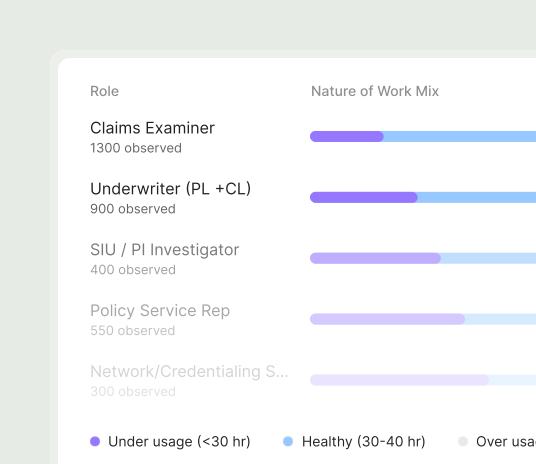
14,000+
hours/year of automation-ready effort
Before, it was turn on AI and hope. Now we know exactly which processes to automate, what we'll save, and how to prove we got there.

Context Graph of Work
Built on 25B+ events. 500+ processes and 1,000+ enterprise apps. The Context Graph of Work is the backbone under the Skan AI platform.

Built from live operational signals, including tacit human knowledge, turnaround times, and decision patterns, not static documentation. The Context Graph of work evolves as your business evolves.
Continuously captures real work at scale covering all process variants, exceptions, workarounds from direct observation of human work, not just documents and event logs. The context AI needs to understand how work gets done.
Every insight traces back to observed work. Transparent, explainable, auditable, and rooted in operational reality.

Blueprint scans across the organization to pinpoint where inefficiency is costing you and where AI can deliver the greatest value.

Real-time, continuous observation
Delivers continuous insights, allowing for dynamic adjustments and traceable outcomes.
Enterprise-grade context at scale
Skan is one of the few work intelligence platforms that can be deployed to observe work at scale, spanning tens of thousands of operators at once.
Advanced AI application
Uses Computer Vision, NLP, and proprietary deep learning models for high fidelity process mapping and context extraction.
Client-owned, privacy-first architecture
All data, context and insights remain client-owned. Sensitive data stays within the client’s secured environment; only anonymized, abstracted metadata is sent to the Skan AI Cloud.


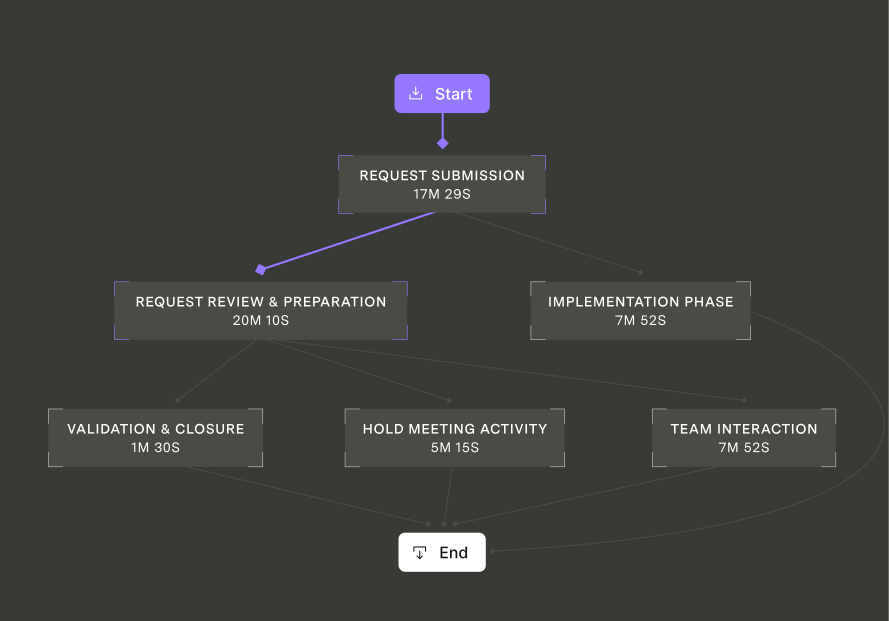
The end-to-end workflows that power your operations, including the exceptions, workarounds and rework loops that never make it into the documentation. The context graph is built from observed activity, and how process mining works is foundational to understanding what that observation captures at scale.
The teams, roles, applications and touchpoints work moves through, with every workflow, skill set and usage pattern connected back to the processes they support.
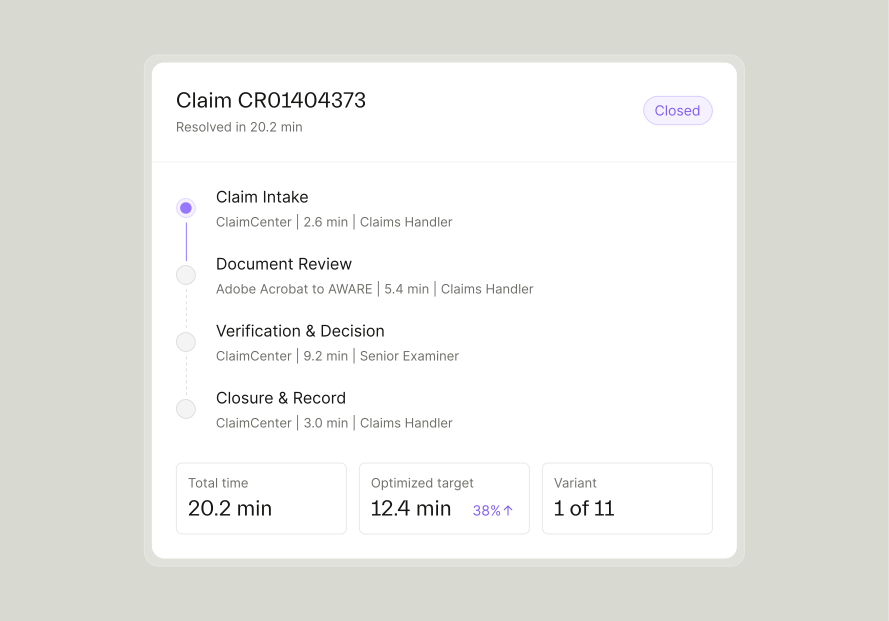
The outputs your operations create — documents, records and business metrics — with clear lineage showing how every outcome connects back to the work that produced it.
A Context Graph of Work is a continuously updated model of how work gets done across an enterprise. It connects workflows, systems, decisions, exceptions and outcomes into a structured view that AI and business teams can use.
A traditional knowledge graph usually connects documented entities and relationships. A Context Graph of Work is built from observed operational activity, so it reflects how work actually flows across systems, teams and exceptions.
Enterprise AI needs operational context to understand how work is performed, where decisions happen, and how exceptions are handled. Without that context, AI systems rely on incomplete documentation or assumptions.
It helps organizations identify improvement opportunities, understand operational performance, prioritize automation, and deploy AI agents grounded in real workflows.