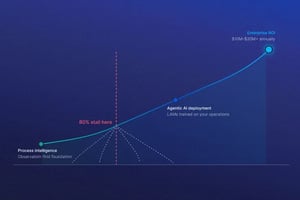
TL;DR: Agentic AI ROI requires process intelligence first. 80% of enterprise AI projects stall before delivering real results. Organizations achieving $10M to $30M+ in annual savings built process intelligence before deploying automation. This article covers the four-phase roadmap, the industry outcome data, and how to assess where your program stands.
Only 6% of organizations report meaningful EBIT impact from AI investment, according to McKinsey's State of AI 2025. Enterprises are committing hundreds of millions of dollars to transformation programs and returning cents on the dollar. The reason, documented consistently across healthcare, insurance, and technology, is the absence of operational context.
This article draws on Skan AI's whitepaper, The Real Impact of Agentic AI in the Enterprise (Q1 2026), built from real enterprise deployments. It shows where agentic AI is delivering measurable results, why most initiatives stall, and what the process intelligence foundation makes possible.
Skan AI's deployment research finds that 80% of agentic AI initiatives stall before they scale. The organizations that achieve measurable agentic AI ROI share one defining characteristic: they built process intelligence before they touched automation.
The Enterprise AI Gap: Enormous Investment, Minimal Transformation
Enterprise AI spending is accelerating, but results are not keeping pace. Organizations across healthcare, insurance, and technology have launched AI task forces, issued roadmaps, and invested heavily in pilots. Yet the majority of those initiatives never produce measurable operational impact.
The problem rests with the foundation. AI trained on documented processes, flowcharts, SOPs, and org charts, learns how work is supposed to happen. That is not the same as how work actually happens. The gap between the two is exactly where automation breaks down.
|
80%
of enterprise AI projects stuck in pilot mode
|
$10M-$30M+
annual savings at organizations that get it right
|
50-70%
less ROI when skipping process intelligence first
|
What Is Agentic AI?
Agentic AI refers to AI systems that can set goals, map context, make decisions, take actions, and validate outcomes across complete workflows, without step-by-step human instruction. Unlike traditional automation, which executes rules, agentic AI understands intent and optimizes for results.
An agentic workflow is a complete business process run autonomously by an AI agent. The agent sets goals, gathers inputs, makes decisions, takes actions across systems, and validates outcomes without step-by-step human instruction. Escalation to a human happens only for genuine exceptions.
The technology behind this capability is the Large Action Model. See the next section for how LAMs differ from the AI models most enterprises have already deployed.
What Large Action Models Do Differently
A Large Action Model (LAM) is an AI model trained on operational workflow data rather than general text. Where a large language model learns from documents and conversations, a LAM learns from the actual sequence of clicks, decisions, approvals, and handoffs that make up your organization's real work.
A LAM that has learned how your claims examiners actually work produces straight-through processing rates your competitors cannot replicate with off-the-shelf models, because their models learned from general data and yours learned from your operations. That results in a durable competitive advantage.
The practical result is AI process automation that improves continuously without additional configuration. Each workflow observed adds training signal. Each agent deployed builds operational knowledge. The ROI compounds rather than plateaus.
The Four Stages of AI Maturity
Enterprise AI has evolved through four distinct stages, each delivering meaningfully higher productivity gains than the last. Understanding where your organization sits on this AI maturity curve is the first step toward closing the gap between AI activity and AI outcomes.
|
Stage
|
Technology
|
Era
|
Typical Productivity Gain
|
|
Stage 1
|
Robotic Process Automation (RPA)
|
2010s
|
10 to 20%
|
|
Stage 2
|
Task Agents (ML/NLP)
|
2015+
|
20 to 30%
|
|
Stage 3
|
Service Agents (multi-channel)
|
2020s
|
40 to 50%
|
|
Stage 4
|
Process Agents, Agentic AI (LAMs)
|
2025+
|
50 to 75%
|
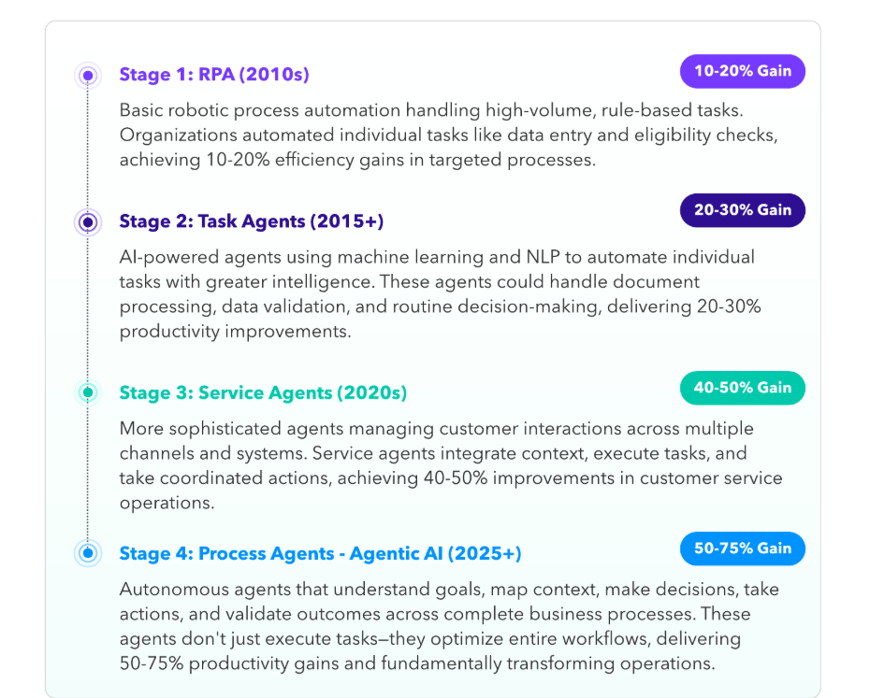
The leap from Stage 3 to Stage 4 is not incremental. Process agents powered by Large Action Models learn your organization's workflows, understand the reasoning behind every process step, and improve over time. Traditional automation fights for 10 to 15% efficiency gains through years of manual configuration. Process agents deliver compounding improvements with less overhead as they mature.
Why Do Most Agentic AI Initiatives Stall?
Three structural failure patterns appear consistently across enterprise AI deployments, regardless of industry or budget. For a detailed breakdown, see our guide on why enterprise agentic AI initiatives stall.
Failure Pattern 1: Built on Documented Reality, Not Observed Reality
Process documentation, flowcharts, and SOPs describe how work is supposed to happen. In practice, real workflows look very different. AI trained on documents learns a fiction. The result is automation that breaks on edge cases, and in operations, edge cases represent the majority of actual work.
Failure Pattern 2: Measuring Model Metrics Instead of Business Outcomes
Model accuracy and inference speed are not business metrics. They do not tell you whether claims processed faster, costs declined, or customers were served better. Without a direct line from AI activity to operational outcomes, organizations cannot justify scale, and cannot course-correct when pilots stall.
Failure Pattern 3: Fragmentation Without a Shared Foundation
AI initiatives running in departmental silos produce local wins and enterprise-wide stagnation. Without a unified data foundation and shared operational strategy, each team optimizes its own corner while the transformation fails to materialize at scale.
Process Intelligence: The Foundation Agentic AI Actually Needs
Every organization in Skan AI's deployment research that achieved seven-figure annual savings solved the same problem first. They built a clear, continuous picture of real operational workflows.
Unlike event-log-based process mining tools, which analyze system records from integrated backends, Skan AI observes 100% of real desktop operations, including the manual steps, workarounds, and cross-application handoffs that no event log captures.
This is process intelligence: the continuous observation of real workflows, capturing every click, keystroke, decision, and handoff across systems. It creates what leading implementations call a digital twin of operations, a comprehensive data model of how work flows through the organization.
That digital twin captures:
- Process flows across claims, underwriting, customer service, and care coordination
- Time stamps that reveal exactly where delays occur
- Application switching patterns that expose inefficiencies
- Task sequences from top performers versus average workers
- Error patterns, exception handling, and team handoffs
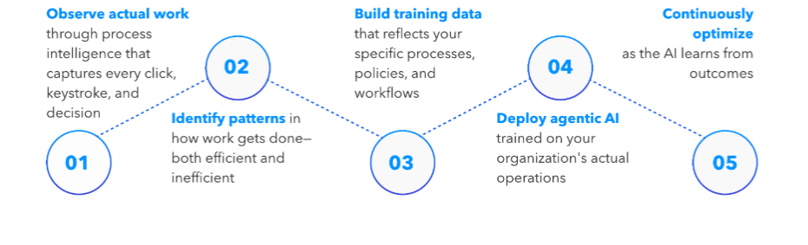
This operational data becomes the training foundation for Large Action Models. The result is AI that does not just know what a task is, it knows how your organization does it. That specificity is what generic AI models cannot replicate.
|
Observation-First Advantage
|
Traditional process mining tools analyze event logs from integrated enterprise systems. They typically capture 15 to 20% of how work actually flows. The remaining 80 to 85% happens in manual steps, workarounds, and cross-application handoffs that no system log records. Skan AI observes 100% of desktop-level interactions across every application, without requiring backend integration.
|
|
Key Insight
|
Organizations that deploy agentic AI without first building process intelligence achieve 50 to 70% less impact than those who start with comprehensive process discovery. The foundation is not optional.
|
For the full deployment dataset behind these findings, download the Skan AI whitepaper: The Real Impact of Agentic AI in the Enterprise
What Agentic AI Deployments Actually Deliver
The documented agentic AI ROI across Skan AI's enterprise deployments spans healthcare payers, insurance carriers, and technology enterprises. Results below reflect actual implementations drawn from Skan AI's whitepaper research, not vendor projections.
|
Industry
|
Highest-ROI Use Cases
|
Documented Outcome Range
|
|
Healthcare Payers
|
Claims processing, prior authorization
|
$6M to $30M in addressable savings; 40 to 50% reduction in processing time
|
|
Insurance Carriers
|
Claims adjudication, document processing
|
$12M to $14M in annual savings; 45 to 60% of claims processed straight-through
|
|
Technology Enterprises
|
Sales ops standardization, customer support
|
$13M to $75M in annual savings; 45 to 50% reduction in case processing time
|
A Fortune 50 healthcare payer saved $13M+ annually across more than 3 million calls by standardizing operations and optimizing capacity. FM Global, a leading commercial P&C insurer, identified $10.5M in annual savings and more than 10 automation opportunities through process intelligence deployed before automation. A Fortune 100 property and casualty carrier built on the same foundation, saving $14M+ in annual claims operations.
From Task Automation to Agentic Workflows: The Persona Model
Traditional automation targeted individual tasks. The highest-value agentic AI use cases go further: automating complete personas, digital workers that understand goals, context, and how to achieve outcomes across an entire workflow.
Consider a claims adjudication agent. It does not process a single task. It runs a full cycle:
- Sets goals and maps context: adjudicate accurately across benefit design, medical policies, and regulatory requirements
- Senses and ingests inputs: claims data, medical records, provider contracts, and member eligibility documentation
- Makes decisions autonomously: validates coding, assesses medical necessity, applies benefit rules, and approves, denies, or pends
- Validates outcomes continuously: measures accuracy rates, processing time, appeal rates, compliance metrics, and member satisfaction
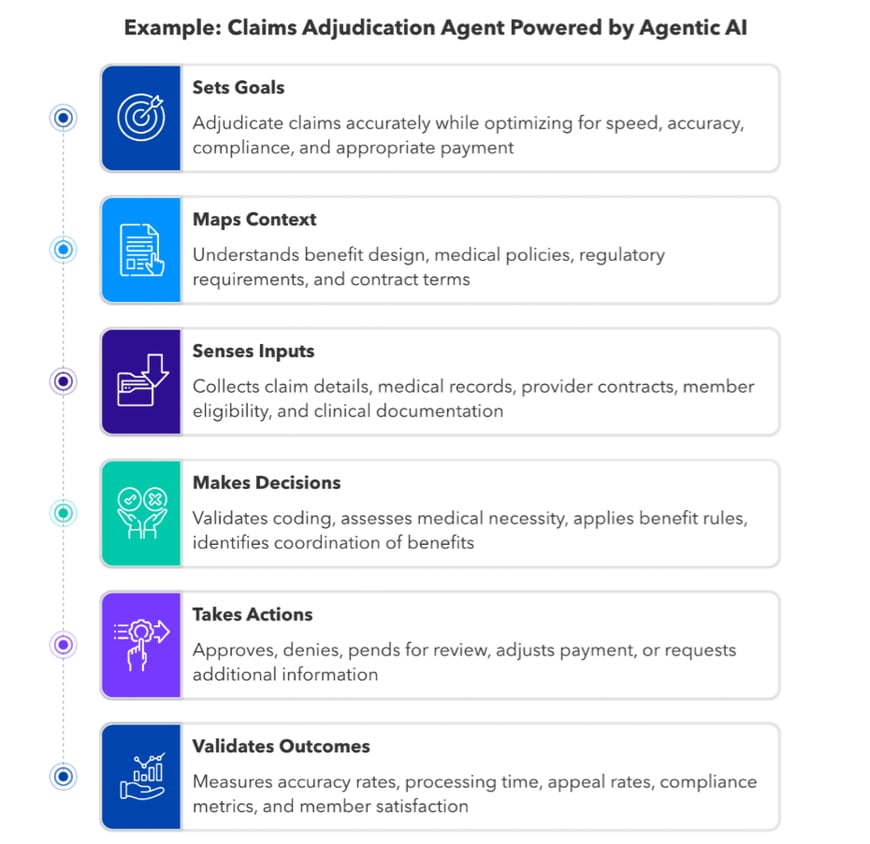
Insurance carriers are deploying agents like this today. These agents differ from earlier automation because of their completeness. Agentic workflows handle the full arc of a business process, not just a slice of it.
The Four-Phase Roadmap to Agentic Automation
Organizations achieving $10M+ in annual savings followed the same four-phase roadmap from process discovery to agentic automation, each phase building directly on the last.
|
Phase
|
Focus
|
Timeline
|
Expected Outcome
|
|
Phase 1: Process Discovery
|
Deploy process intelligence. Build your digital twin. Identify inefficiencies, automation opportunities, and training gaps.
|
Within a few weeks
|
Comprehensive process map with prioritized automation opportunities and projected ROI
|
|
Phase 2: Process Optimization
|
Before automating, optimize. Eliminate unnecessary steps, standardize best practices, and consolidate redundant workflows.
|
Within the first few months
|
15 to 25% efficiency improvement through optimization alone
|
|
Phase 3: Intelligent Automation
|
Deploy AI agents for high-impact use cases: document processing, automated triage, decision support, and exception handling.
|
Within a few months
|
30 to 40% additional productivity improvement, with clear ROI in months
|
|
Phase 4: Agentic Automation
|
Evolve to full process agents. Handle complete workflows autonomously. Escalate only true exceptions. Optimize continuously.
|
Within the first year
|
50 to 75% total improvement; $10M+ in annual savings for enterprise deployments
|
Agentic AI implementation sequencing matters more than most programs anticipate. Skipping Phase 1 and Phase 2 and jumping straight to automation is the single most common cause of underperformance in enterprise AI deployments. The foundation phases are not delays, they are what makes the ROI phases possible.
A consistent finding from Skan AI's deployment research: the accuracy of Phase 3 agents is meaningfully higher for programs that completed Phase 2 optimization first. Skipping Phase 2 to accelerate automation typically requires a remediation phase that costs more in time and resources than Phase 2 would have.
For the full strategic implementation methodology behind this roadmap, see our process intelligence strategy guide.
Six Critical Success Factors for Agentic AI Implementation
The organizations that achieve transformational results share six common characteristics. Scale, industry, and starting point differ. These factors do not.
Executive Sponsorship
VP or C-level commitment is the most reliable predictor of enterprise AI program success. Sponsors who commit to operational transformation, not just cost reduction, secure the resources, organizational alignment, and change management infrastructure that cross-functional AI programs require.
Data-Driven Approach
Investment in the Skan AI process intelligence platform before automation is the single highest-leverage decision in the deployment sequence. Organizations that skip this step achieve 50 to 70% less impact than those that build the observation foundation first.
Change Management
Proactive workforce planning is a Phase 1 deliverable, not an afterthought. Programs that achieve the highest adoption rates frame automation as eliminating repetitive tasks and freeing staff to focus on the complex, high-value work that agents cannot handle.
Iterative Implementation
Enterprise-wide automation rollouts attempted simultaneously collapse under complexity. High-performing programs identify two to three high-impact agentic AI use cases, prove ROI at meaningful scale, and use that evidence to secure resources for the next phase.
Continuous Optimization
Agentic AI programs that plateau are programs treated as deployments. Programs that compound are treated as capabilities. The difference is whether there is an active process for feeding new operational observations back into the models.
Ethical Framework
Clear governance around AI decision-making, bias detection, and human oversight is a deployment requirement in healthcare and insurance, not a compliance checkbox. Agents making coverage and payment decisions need documented escalation paths and audit trails from day one.
Is Your Organization Ready to Move from AI Activity to AI ROI?
The path from AI experiment to AI ROI follows a predictable pattern. Most enterprises are stuck in one of four stages.
- Activity Without Visibility: AI pilots running in silos. No unified view of how operations flow across the organization. This is where the majority of enterprises sit today.
- Visibility Without Action: Process intelligence deployed and an operational baseline established, but automation decisions still made on instinct rather than observed data.
- Action Without Scale: High-impact use cases proven and ROI documented in targeted areas, but fragmentation is preventing enterprise-wide momentum.
- Scaled Operational Intelligence: Process intelligence and AI operating as a continuous system. Outcomes measured at the business level. Competitive advantage compounding.
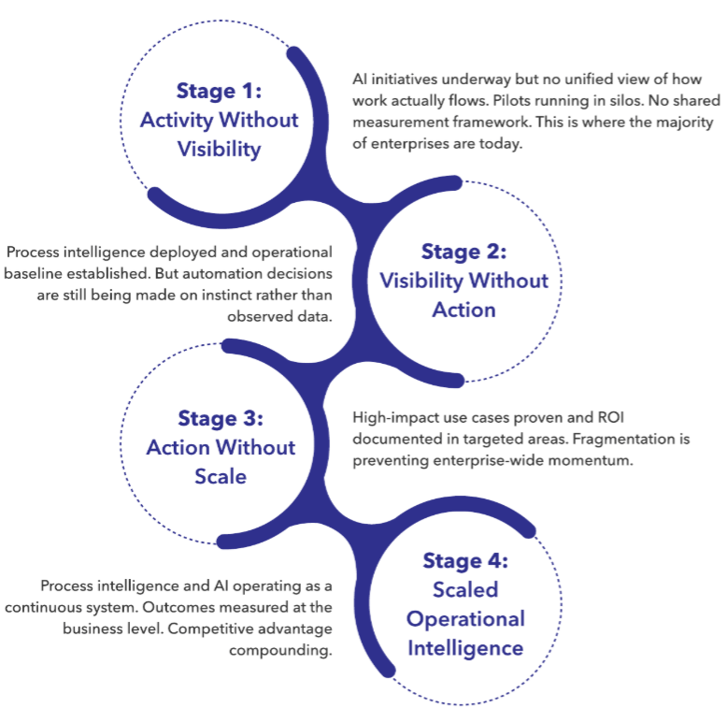
The gap between the "Activity Without Visibility" stage and the $15M to $30M outcomes documented in Skan AI's research is not a technology gap. It is a foundation gap. The organizations closing it fastest are the ones who started with process intelligence before they touched automation.
Gartner projects that over 40% of enterprise agentic AI projects will be canceled by 2027, citing escalating costs and unclear business value as the primary drivers. Analysis of programs that stalled between 2023 and 2025 consistently identifies incomplete process data as the contributing factor.
Enterprises that build a structured observation data layer now will have the context advantage when agentic AI scales. The operational knowledge accumulated through continuous observation becomes structurally difficult for later movers to replicate at speed. Programs that follow the observation-first sequence compound that advantage with every workflow observed, every agent deployed, and every process improved.
To explore how the four-phase roadmap applies to your specific operations: request a demo
 ChatGPT
 Perplexity
 Grok
Grok
 Gemini
 Claude