TL;DR: Enterprise AI programs are returning less than 6% meaningful financial impact, according to McKinsey's 2025 State of AI research. For sales transformation leaders, that figure names a familiar problem: significant investment, limited return, and the same root cause almost every time. The operational data layer is missing.
Sales cycles are getting longer and quota attainment rates are declining at enterprise organizations. Transformation investments keep missing their targets despite growing budgets. The answer is the same in almost every case: the data being used to drive decisions does not reflect how work really happens.
Why Do Enterprise Sales Transformation Programs Fail?
Enterprise sales transformation fails most often because it is built on assumptions rather than observations of real workflows. The programs that underperform share a consistent structural feature: the operational data driving transformation decisions is incomplete, outdated, or both.
So when the sales team invests in new systems, redesigned workflows, and training programs, those investments and projects are built on a foundation of guesswork. The introduction of agentic AI transformation has only accelerated that cycle. And that will continue to be the reality until sales organizations gain visibility into how work moves across their teams and tools.
There are three recurring patterns that drive failing transformation initiatives in enterprise sales today:
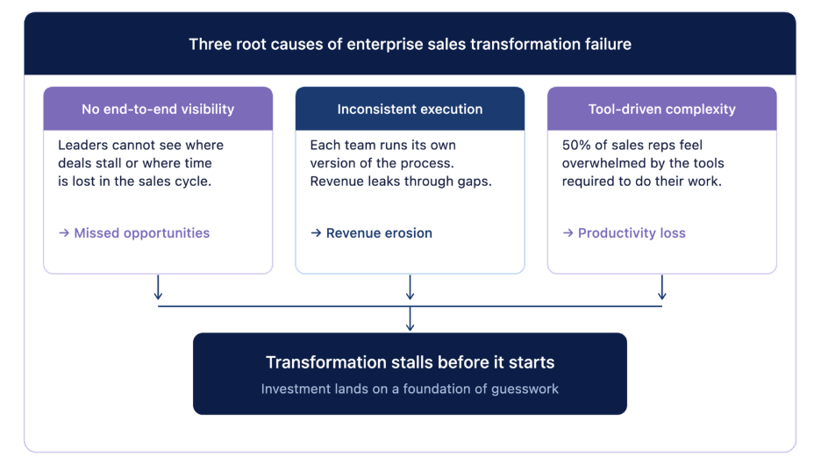
- Lack of end-to-end visibility: Leaders cannot see where deals stall, where processes break down, or where time is lost across the full sales cycle.
- Inconsistent execution: Different teams, segments, and territories follow different versions of the same process. Revenue leaks through the gaps.
- Tool-driven complexity: The systems designed to increase productivity often add cognitive load instead. Research from Harvard Business Review (2023) found that 50% of sales reps feel overwhelmed by the number of technologies required to do their work.
The result is a transformation program that moves forward without the operational context needed to make it work.
What Does an Operational Blind Spot Look Like in Sales?
An operational blind spot is the gap between how a process is designed to work and how it runs in practice. In enterprise sales, that gap is substantial.
Consider a VP of Sales Operations reviewing their CRM dashboard. A 90-day deal is stuck in solutioning. The timestamp says the quote was sent three weeks ago and the process was followed.
What the CRM does not show is the 14-step manual workaround the rep built around the quoting tool, the three systems toggled to assemble the proposal, or the two approval requests that never reached the right inbox. The bottleneck is invisible to every reporting layer the team has access to.
Sales data exists in CRMs, ERPs, quoting platforms, email threads, and customer call records. Traditional process mining and event-log tools capture only 15 to 20% of actual work because they cannot observe desktop-level activity. The remaining 80 to 85% of actual work flows through the human-system interactions between those tools: the manual steps, workarounds, and cross-application handoffs that no event log records.
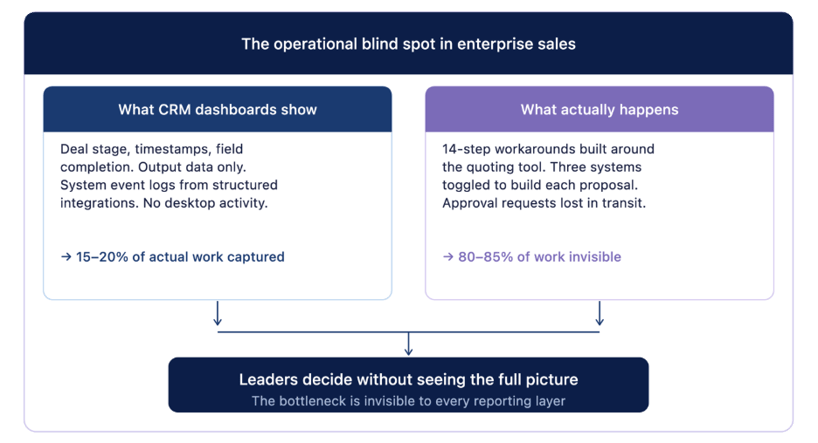
That unstructured layer is where the real work happens: the manual steps reps take between systems, the workarounds built into the quoting process, the micro-decisions made during customer interactions. None of that is visible in a CRM report or a system event log.
The practical consequences for sales leaders include:
- Missed upsell and cross-sell signals because account activity patterns go undetected
- Slow deal velocity driven by bottlenecks that nobody can locate and measure
- Inconsistent time to proficiency for new sellers because best practices remain invisible
- Automation programs that fail because they are built on incomplete process data
What Is Process Intelligence for Sales Operations?
Process intelligence is the capability to capture, analyze, and improve how work happens across an enterprise, but it doesn’t translate to successful sales transformation unless your organization does two key things:
- Ensures that all operational context is captured, including the undocumented workarounds and micro-decisions that aren’t captured in a CRM or system event log.
- Builds context, governance, and measurement into your AI infrastructure so agents are trained on complete operational context, make auditable decisions, and are optimized against impact-aligned performance metrics over time.
Observation-based agentic process intelligence is the practice of using observed operational data to inform, train, and govern AI agents that execute work autonomously. Unlike traditional process intelligence and process mining, work observation captures every step a seller takes across every system they touch, not just the outcomes that get logged in a CRM. The result is a digital twin of operations, a continuously updated model of how the sales process flows in reality, rather than how it was documented in a process design specification.
This approach captures the full picture of how work happens. That includes:
- Manual steps taken outside prescribed workflows
- Application and tool usage patterns across the sales cycle
- Time and effort breakdowns by process stage, team, and territory
- Exception paths and workarounds that erode efficiency at scale
Skan AI observes100% of desktop-level activity across every application without requiring system integrations. Traditional event-log tools capture roughly 15 to 20% of actual work. The 80 to 85% they miss is exactly where manual steps, workarounds, and decision logic accumulate.
How Does Process Intelligence Address Sales Complexity?
Process intelligence does not add another tool to the sales stack. It creates the operational ground truth (an observation-based, continuously updated picture of how work actually flows) that makes every other tool more effective.
In enterprise sales environments, that plays out across four critical areas:
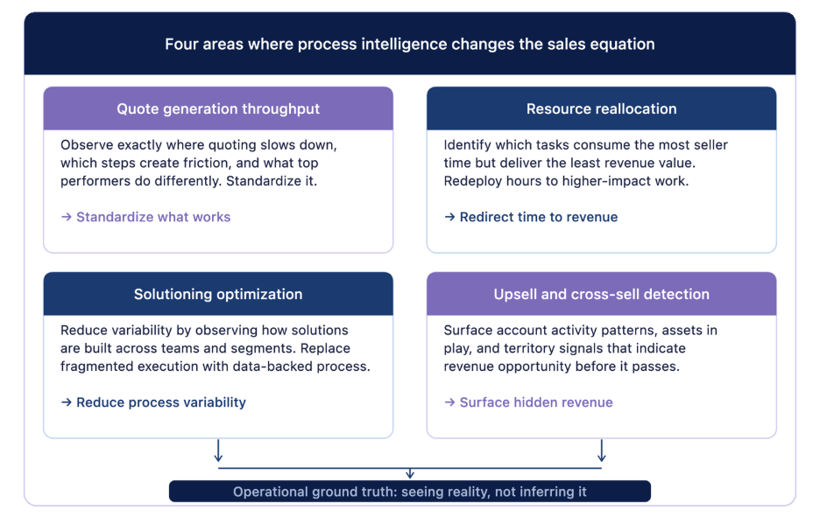
1. Quote generation throughput: Observe exactly where the quoting process slows down, which steps create the most friction, and what separates high-performing sellers from the average. Then standardize around what works.
2. Resource reallocation: Identify which tasks consume the most seller time but deliver the least revenue value. Redeploy those hours toward higher-impact activities without relying on surveys or manager perception.
3. Solutioning and quoting optimization: Reduce process variability by understanding how solutions are built across different teams and segments. Replace fragmented execution with a consistent, data-backed approach.
4. Upsell and cross-sell signal detection: Surface account activity patterns, assets in play, and territory dynamics that indicate revenue opportunity. Give sales leaders a clear picture of what is happening inside each account.
Each of these use cases starts from the same foundation: seeing the real state of operations, rather than inferring it from incomplete data.
What Business Outcomes Have Sales Organizations Reported?
Production deployments of process intelligence across Fortune 500 enterprises show a consistent pattern: when leaders can see how work flows, they improve it with precision rather than approximation.
One global hi-tech company with 25,000 sales representatives identified millions in estimated annual savings after deploying process intelligence across its CRM and sales application workflows. The deployment surfaced how top-performing sellers operated differently, creating a replicable model for the broader team.
Across regulated enterprise environments in banking and insurance, a major US health insurer separately identified $28M in annual savings across 26,000 frontline agents using the same observational foundation.
Reported outcomes across enterprise deployments include:
|
Metric
|
Reported range
|
|
Annual savings identified
|
$10M to $28M per Fortune 500 deployment
|
|
Productivity improvement
|
20 to 35% in frontline operations
|
|
Cycle time reduction
|
30 to 40% across core workflows
|
|
Non-value-added activity reduction
|
Up to 40%
|
The gains compound over time because the underlying data layer continues to update as the operation evolves.
How Does Process Intelligence Connect to an Agentic AI Strategy?
Agentic AI requires operational ground truth to function. AI agents that make decisions and execute workflows autonomously need accurate, current data about how those workflows run in practice. Without it, they operate on assumptions and fail in the same ways traditional automation has always failed.
Gartner's 2025 research projects that over 40% of enterprise agentic AI projects will be canceled by 2027 due to the absence of operational context. Analysis of programs that stalled between 2023 and 2025 consistently identifies the same root cause: agents designed on assumed process maps rather than observed ones.
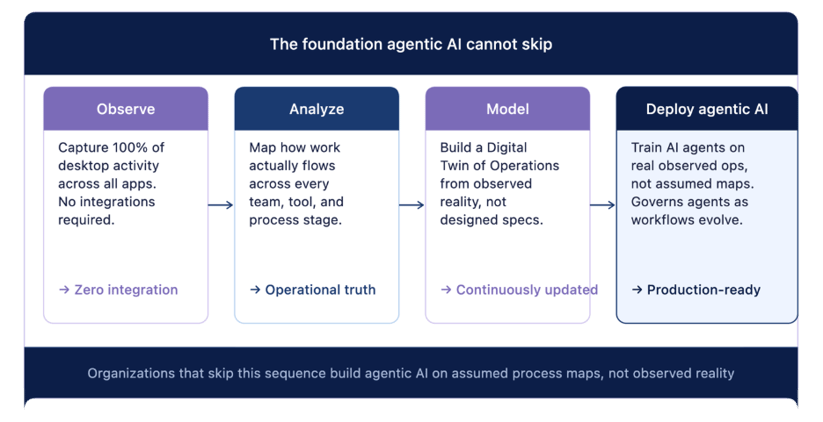
That operational ground truth is what process intelligence provides. By directly observing how work happens across human and system touchpoints, Agentic Process Intelligence creates the data foundation that enterprise AI programs need to move beyond pilots and into production.
The path forward is sequential. Organizations that attempt to deploy agentic AI without first establishing process intelligence are skipping a foundational stage. The data layer cannot be retrofitted: it needs to be in place before agents go to work.
Enterprises that build this foundation now establish a structural advantage that compounds. The process knowledge base generated through direct observation becomes progressively harder for later movers to replicate as agentic AI scales. Programs that have made this shift report measurable improvements in agent reliability and a reduction in remediation cycles across each subsequent deployment.
 ChatGPT
 Perplexity
 Grok
Grok
 Gemini
 Claude