TL;DR: Contact center performance problems are rarely agent problems; they are process problems hidden inside technology transitions that traditional workforce analytics cannot see. Skan AI's process intelligence platform observes every desktop interaction across all applications in real time, giving contact center leaders the operational ground truth to identify recoverable waste, verify ERP adoption, and replicate top-performer workflows at scale.
You rolled out a new ERP. You invested in a digital adoption platform. You ran the training. Six months later, average handle time is still high, after-call work is unpredictable, and your top performers are working harder than everyone else for reasons no one can explain.
The problem is not effort. The problem is visibility. Traditional workforce analytics tells you what happened. Process intelligence software shows you exactly why, step by step, across every application your agents touch.
What is Process Intelligence, and Why Does it Matter for Contact Centers?
Process intelligence is continuous, real-time observation of how agents actually work across every application, capturing every task, screen transition, and decision as it happens.
Unlike event log-based process mining, process intelligence does not rely on system records after the fact. It observes human-system interactions as they occur, on every desktop, at scale. The result is a complete digital twin of operations: an accurate, current model of how work flows in practice.
For a contact center, that means you stop inferring performance from call recordings and ticket timestamps. You see the full picture: which applications agents switch between, how many steps separate a query from its resolution, and where each second of handle time is spent across each step.
Why Does ERP Change Management Stall in the Contact Center?
ERP implementations are considered complete when the system goes live. But live does not mean adopted, and adopted does not mean efficient.
Most ERP change management programs measure adoption by login rates and training completion. Neither metric captures whether agents are using the new system effectively. An agent who completes training and logs in daily may still be working around the ERP in ways that add minutes to every call.
Digital adoption platforms track clicks and navigation paths within a single application. They cannot see what agents do before they enter the ERP, after they leave it, or when they open a workaround in a parallel window. That gap is where contact center performance gets lost.
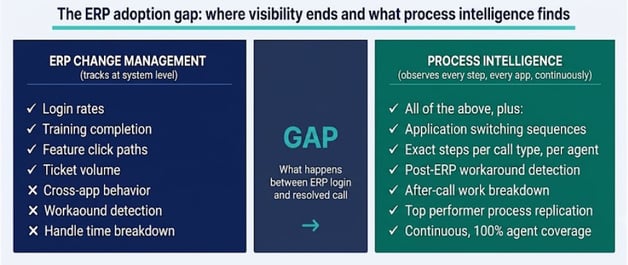
What ERP Adoption Gaps Typically Look Like in Contact Center Data
- Agents toggling between the ERP and legacy systems for the same transaction
- After-call work extending because notes require manual re-entry across platforms
- Training procedures that describe ideal paths, but observed paths that diverge significantly from them
- High variability in handle time between agents completing identical call types
What Does Workforce Analytics Miss That Process Intelligence Reveals?
Workforce analytics tells you an agent took 9 minutes on a call. Process intelligence tells you 3 of those minutes were spent in the wrong application because the ERP lookup failed silently.
Workforce analytics tools aggregate outcomes. They surface that one team handles calls 40% faster than another, or that overall first-call resolution is declining. That is useful, but it’s not sufficient.
Process intelligence operates at the task level. It captures every application interaction, every screen transition, and every deviation from the standard path. Traditional desktop analytics tools measure output metrics: aggregate handle times, call volumes, and resolution rates. They do not capture the application-level sequence that produces those metrics. Process intelligence observes the full path, not the summary, making it possible to identify the exact steps separating your top performers from the rest of the team.
|
Capability
|
Workforce analytics
|
Process intelligence software
|
|
Handle time by agent
|
Yes
|
Yes, plus step-by-step breakdown
|
|
After-call work duration
|
Total only
|
Task-by-task observation
|
|
Application switching patterns
|
No
|
Full cross-app visibility
|
|
ERP adoption vs. workaround detection
|
No
|
Yes, at transaction level
|
|
Best-performer process capture
|
Output metrics only
|
Exact step replication
|
|
Scale of observation
|
Sampled or surveyed
|
100% of agents, continuously
|
How Does a Context Graph of Work Change Contact Center Improvement?
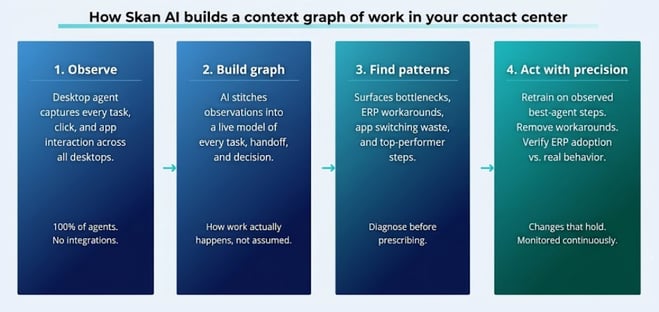
A context graph of work is a continuously updated model of every task, handoff, and decision across your contact center. It is built from observation, not documentation.
Most process improvement programs begin with interviews, surveys, or process maps written months before anyone asked the agents who perform the work. Those documents describe how work is supposed to happen. A context graph of work describes how work genuinely flows, updated in real time.
Skan AI builds this graph through continuous observation of desktop activity across every application. It captures the informal shortcuts your best agents have developed, the failure points your ERP rollout introduced, and the after-call patterns that are adding cost to every transaction. That operational ground truth becomes the foundation for targeted improvement, agent training, and AI automation that reflects reality rather than assumption.
What Results Do Contact Centers See With Process Intelligence?
Process intelligence consistently delivers measurable reductions in handle time, after-call work, and cost per call when applied to contact center operations.
These outcomes share a common starting point: observing what is actually happening before prescribing what should change. Enterprises committing to AI-driven transformation that begin with a process observation baseline reach clear answers faster and implement changes that hold, because the data reflects operational reality rather than assumptions.
See how Skan AI identified $15 million in contact center savings for a Fortune 500 financial services company by observing how agents navigated between their CRM, ERP, and document platforms: contact center optimization case study.
How does Skan AI apply process intelligence to contact center operations?
Skan AI observes every desktop interaction across all applications, without workflow disruption or complex integrations, and converts that observation into actionable process data.
The Skan AI process intelligence platform deploys an observation agent on each desktop. It captures every task and application interaction in real time, then uses AI to construct a digital twin of operations. For contact center leaders, this means four specific capabilities:
- Top performer benchmarking: Identify the exact steps used by your fastest agents and convert them into training standards for the full team.
- Application usage analysis: See which systems agents use and how cross-application switching adds to handle time and after-call work. Explore Skan AI’s Productivity Cockpit for workforce-level visibility into application patterns.
- Bottleneck elimination: Find the specific process steps that slow every agent and address them systematically to improve first-call resolution.
- ERP adoption verification: After any system rollout, confirm whether agents are using the new platform as intended and where deviation is occurring.
What Should Contact Center Leaders Do Before Their Next Technology Rollout?
Technology investments in contact centers fail most often not because the tools are wrong, but because the processes receiving those tools were never fully understood. Gartner’s 2025 research found that over 40% of agentic AI projects will be canceled by 2027 due to the absence of operational context, the same structural gap that causes ERP rollouts to underdeliver in contact centers.
An ERP deployed into a workflow that already has workarounds will inherit those workarounds. A digital adoption platform that measures clicks cannot show you whether the clicks are in the right sequence. Process intelligence software provides the operational ground truth that every transformation program requires.
- Run a process intelligence baseline across a representative sample of agents and call types before any system change.
- Use the observed data to define the target state, not a documented process map.
- Monitor adoption after rollout by comparing observed behavior to the baseline, not by tracking logins.
- Use top-performer process data as the training standard rather than procedure documentation.
- Continuously monitor for regression to previous patterns after training or technology changes.
 ChatGPT
 Perplexity
 Grok
Grok
 Gemini
 Claude