In 2024, TD Bank paid $3.09 billion in penalties for AML failures. The fine was not the result of a single bad actor or a surprise regulatory shift. Rather, it was the outcome of a monitoring gap that quietly compounded for years across 92% of the bank's transaction volume.
The uncomfortable reality for compliance leaders is this: the same structural weaknesses that brought down TD Bank exist inside most large US financial institutions today. These companies are unable to see exactly where compliance processes break down, and why.
What Is AML Compliance, and Why Is It So Challenging to Get Right?
AML compliance refers to the set of policies, controls, and operational processes that financial institutions use to detect and report money laundering activity. In the United States, these programs are governed by the Bank Secrecy Act (BSA) and enforced by regulators including FinCEN, the OCC, and the Federal Reserve.
Getting it right is more difficult than most organizations want to admit. According to McKinsey, banks detect only 2% of global financial crime flows despite dedicating 10-15% of their workforce to AML activities. The program may look complete on paper. In practice, the human processes that execute it are inconsistent, manual, and difficult to observe.
Why Are Traditional AML Compliance Approaches Breaking Down?
Three structural failures explain why most AML programs fall short, even well-resourced ones.
1. Manual processes create compliance blind spots.
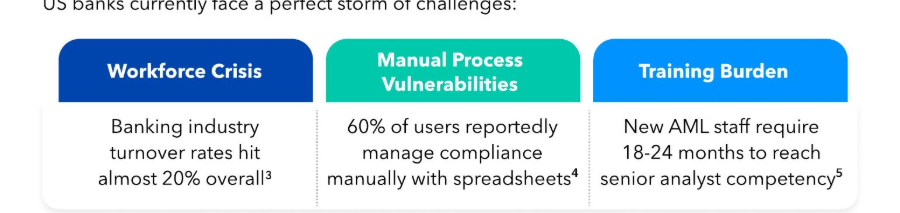
US banks continue to rely on spreadsheets and email-based document collection for critical compliance steps. A recent survey by Hawk AI found that 60% of compliance users manage AML processes manually. Periodic reviews and manual reporting create detection delays that allow suspicious activity to go unreported for months.
Most traditional process mining tools analyze event logs from connected systems, capturing an estimated 15-20% of the work being done. Workflows that happen outside core systems, including manual workarounds, application switching, and exception handling, remain invisible to those tools. That blind spot is where compliance failures develop.
2. Workforce instability undermines program consistency.
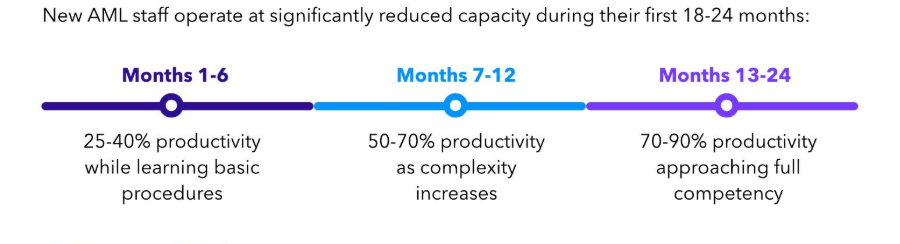
Banking industry staff turnover now sits at approximately 20%. New AML analysts require 18 to 24 months to reach senior-level competency. That ramp-up creates a window of reduced effectiveness: new hires operate at 25-40% productivity in their first six months. High turnover compounds this problem by continuously restarting the cycle.
3. Legacy technology cannot adapt fast enough.
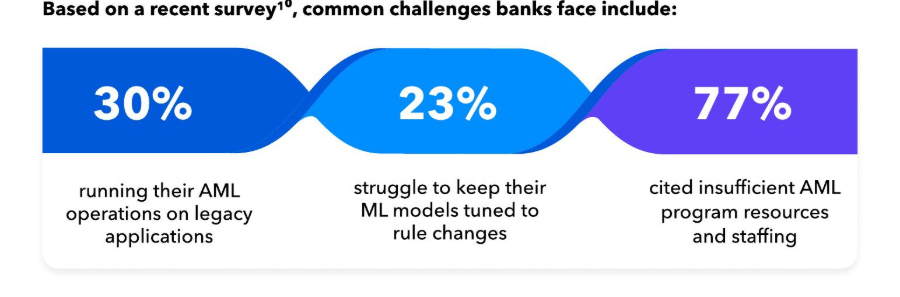
Approximately 30% of institutions run AML operations on legacy applications. Another 23% struggle to tune their ML models to keep pace with rule changes. The technology layer is not keeping up with regulatory velocity. The human layer is left to compensate.
The average annual cost of non-compliance has increased 45% since 2011, reaching nearly $40 million per institution per year. That figure does not include the existential risk of enforcement actions at the scale of TD Bank or Danske Bank's $2.06 billion penalty.
The Hidden Costs of AML Compliance
The visible costs are substantial. The hidden costs are what break programs silently.
People costs are larger than most compliance leaders account for:
- Replacing a single AML analyst costs between $75,000 and $150,000 when recruitment, training, lost productivity, and knowledge transfer are included (WorkFusion, Hidden Costs of AML and KYC Operations)
- Hiring and placement alone runs $15,000 to $25,000 per position
- Productivity losses persist for six to eighteen months at reduced effectiveness during ramp-up periods
Process costs accumulate through rework and delay:
- Alert investigations require 60 minutes to 24 hours of manual review per alert
- Suspicious Activity Report (SAR) backlogs compound as false positives overwhelm reviewer capacity
- Data entry errors, incomplete investigations, and system integration failures generate rework that often goes untracked
Audit preparation is a hidden cost center that grows with complexity:
Large banks often spend $10,000 per employee on compliance. For an institution with 20,000 employees, that translates to $200 million in annual compliance spend. When documentation is poor and processes are inconsistent, regulatory examinations become expensive reconstructions rather than straightforward reviews.
AI's Role in Modernizing AML Operations
AI in AML programs is not primarily about transaction monitoring. It is about understanding and improving how people actually work.
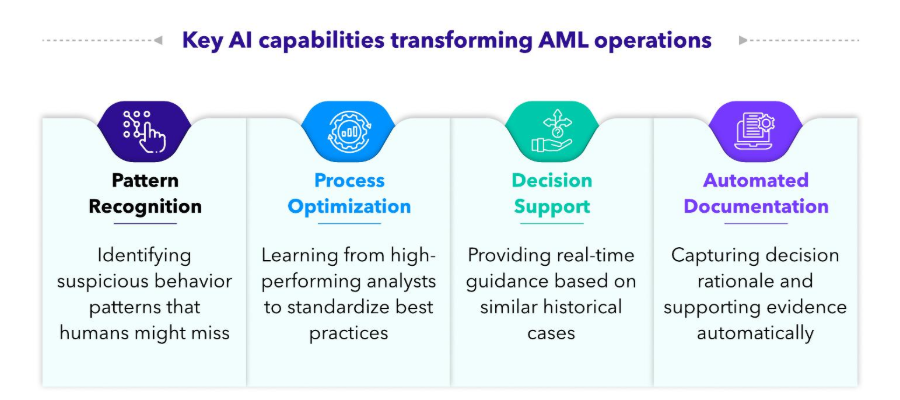
This distinction matters. Traditional AML technology analyzes structured data well. It does not capture the nuanced decision-making of an experienced analyst: how they weigh risk factors across multiple systems, when they escalate a case, how they document their rationale. That institutional knowledge transfers poorly through training documentation and exits the organization every time a senior analyst leaves.
Ninety-three percent of banks plan to use AI to augment rather than replace staff capacity, recognizing that human expertise remains essential for complex compliance decisions (Federal Reserve, 2024). These institutions need to ask whether that AI has been trained on the actual behaviors that make compliance programs effective.
Observation-first process intelligence platforms take a fundamentally different approach. Rather than automating predefined workflows, they observe how work actually happens: which applications are used, in what sequence, with what timing, and with what outcomes. That behavioral data becomes the operational ground truth that AI agents require to replicate expert-level judgment at machine speed.
Enterprises that build this observation data layer now will hold a structural compliance advantage as agentic AI scales across financial services operations. According to Gartner's 2026 Hype Cycle for Agentic AI, only 17% of organizations have deployed AI agents to date, yet more than 60% expect to do so within the next two years, representing the most aggressive adoption curve of any emerging technology currently tracked. Institutions that establish operational readiness now will not be starting from scratch when that wave arrives.
What Is Process Intelligence, and How Does It Apply to AML Programs?
Process intelligence is a category of operational technology that captures the full sequence of how work is performed, not how it is supposed to be performed.
Skan AI's observation-first approach starts before drawing any conclusions about how compliance work should happen. The platform watches how compliance work happens: across every application, every workflow step, and every decision point across the compliance function. This produces a digital twin of operations, a continuously updated replica of AML operations that reflects process reality rather than documented procedure.
Unlike traditional monitoring tools that focus on transaction data, Skan AI observes the human layer of compliance: where analysts spend time, where steps are skipped, where documentation falls short, and where SAR filing deadlines are at risk.
Key capabilities that apply directly to AML programs include:
- End-to-end process mapping: Visualize complete workflows from alert generation through SAR filing, including application switching and manual workarounds
- Real-time compliance monitoring: Detect deviations from standard operating procedures as they happen, not during a quarterly review
- Gap identification before regulatory findings: Flag incomplete documentation, missed process steps, and timing violations before they appear in an examination
- Continuous control validation: Move from periodic compliance testing to real-time monitoring of whether controls are working as intended
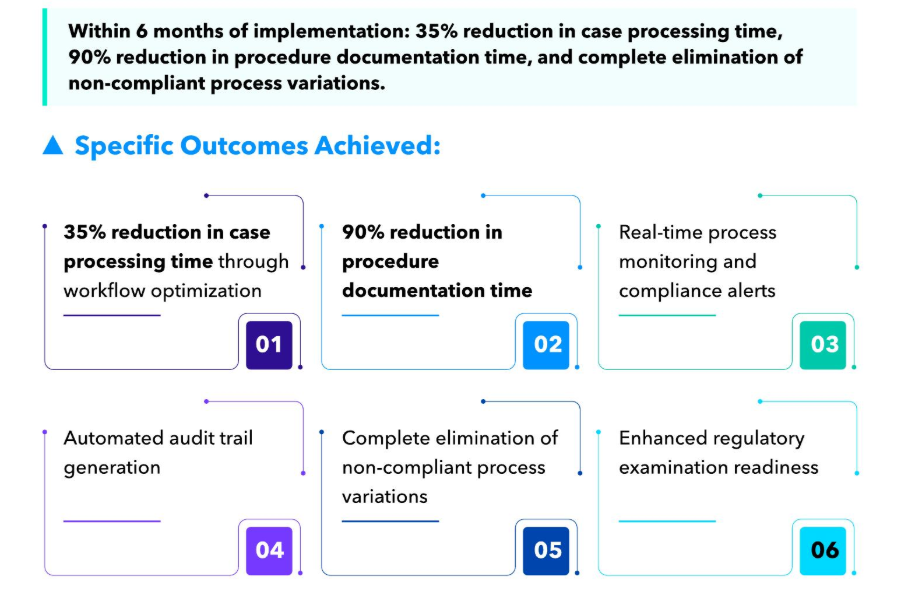
A major Fortune 100 bank implemented Skan AI across its AML operations and achieved a 35% reduction in case processing time, a 90% reduction in procedure documentation time, and complete elimination of non-compliant process variations (per Skan AI implementation data).
Five Ways Process Intelligence Reduces AML Risk
The risk reduction comes through five mechanisms that address the root causes of program failures.
Procedure standardization: Skan AI identified and eliminated 47 distinct process variations in one bank's compliance operations, each a potential regulatory gap. Standardizing how analysts complete investigations eliminates the inconsistency that examiners flag (per Skan AI implementation data).
Accelerated training: New analyst time-to-proficiency was reduced from 18 months to 12 months by providing real-time guidance modeled on the behavior of top-performing analysts. New hires learn from observed best practices, not outdated procedure documents (per Skan AI implementation data).
SAR backlog prevention: Real-time deadline tracking and workload monitoring prevent the backlog conditions that contributed directly to TD Bank's historic penalty. For a detailed examination of how process intelligence resolves SAR backlogs operationally, see How Process Intelligence Fixes SAR Backlogs.
Audit-ready documentation: Banks using Skan AI reduce regulatory examination preparation time by up to 75% through automated documentation and audit trail generation (per Skan AI implementation data). When an examiner arrives, the evidence is already organized.
Human-to-AI knowledge transfer: Skan AI observes and codifies how expert analysts make decisions, capturing the contextual judgment that cannot be extracted from system logs alone. That knowledge trains AI agents across banking operations to replicate expert-level decision-making at scale.
Measurable Outcomes from AML Process Intelligence Deployments
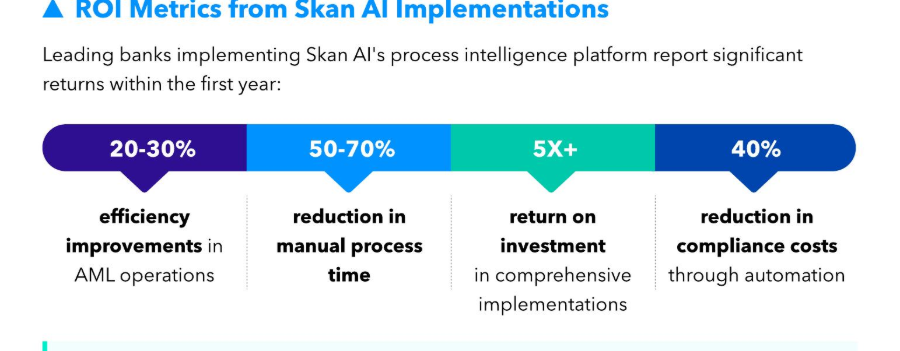
Institutions implementing Skan AI's process intelligence platform report the following results across their compliance functions (per Skan AI implementation data):
|
Outcome
|
Result
|
|
AML operations efficiency improvement
|
20-30%
|
|
Reduction in manual process time
|
50-70%
|
|
Return on investment (comprehensive)
|
5X+
|
|
Reduction in compliance costs
|
40%
|
|
Reduction in exam preparation time
|
Up to 75%
|
|
Decrease in process-related findings
|
67%
|
|
Improvement in compliance team retention
|
31%
|
|
Increase in cases processed per analyst
|
23%
|
These results reflect deployments at Fortune 100 financial institutions. The AI-based AML solution market is projected to grow from $3.37 billion in 2024 to $13.54 billion by 2034, a 14.48% compound annual growth rate (MarketsandMarkets, 2024).
What Should Compliance Leaders Prioritize Now?
The regulatory environment is moving toward continuous oversight. Regulators are adopting their own analytics tools and expecting institutions to demonstrate proactive program management, not just documented policies.
Analysis of recent enforcement actions identifies three operational gaps that consistently appear in AML program failures.
Process visibility gaps. Institutions that cannot trace exactly how analysts complete investigations across every system they touch carry a documentation gap that examiners will find. The TD Bank enforcement record identified this as a central failure: monitoring blind spots compound silently until they become catastrophic.
SAR backlog exposure. Programs that lack real-time deadline tracking accumulate SAR filing delays in ways that are invisible until they become regulatory findings. Measuring average time between alert generation and SAR filing is a leading indicator of systemic compliance risk.
AI trained on incomplete operational data. Controls monitoring initiatives that deploy AI on transaction log data alone replicate the same 15-20% visibility limitation that defines traditional process mining. Building AI on observed human behavior produces agents that reflect how expert analysts actually work, not how they are supposed to work.
Institutions that establish a process intelligence foundation built on direct work observation now are building a compliance advantage that compounds over time. Early movers gain the operational data lead that later entrants cannot quickly replicate. The AI-based AML market is expanding rapidly, and the programs with the deepest operational ground truth will generate the most reliable AI outcomes.
 ChatGPT
 Perplexity
 Grok
Grok
 Gemini
 Claude