Whitepapers & eBooks
Apr 23, 2025


The world is building AI agents at an extraordinary pace. But we're speaking different languages while doing it.
One team calls it a "workflow." Another calls it an "agent." A third insists it's a "process." Same technology, different vocabularies—and that linguistic chaos is costing us dearly in governance gaps, brittle integrations, and stalled enterprise adoption.
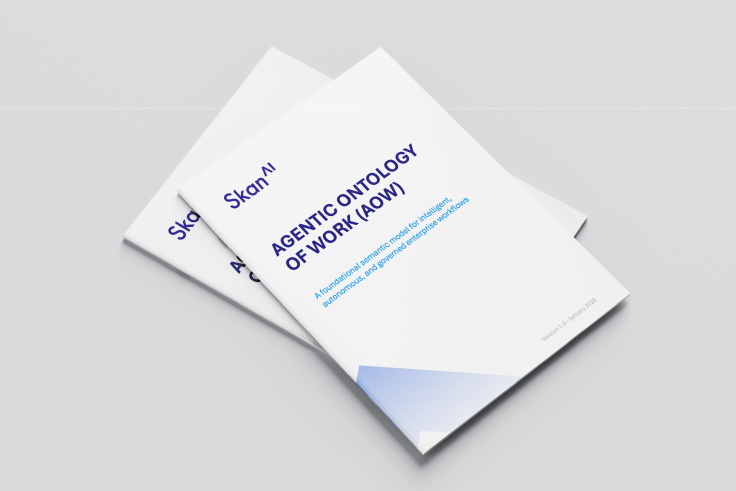
This is precisely the problem that drove us at Skan to develop The Agentic Ontology of Work (AOW). This formal semantic framework gives enterprises a shared language for describing, governing, and scaling intelligent automation.
Why does this matter now?
We're at an inflection point. The convergence of multi-agent systems, learned behaviors, contextual awareness, and enterprise observability is creating systems that don't just automate, they understand, reason, and act across complex operational landscapes. But without a common ontology, we're building Tower of Babel systems that can't talk to each other, can't be properly governed, and can't scale safely.
Think back to Service-Oriented Architecture. SOA didn't just provide technical patterns—it gave us a vocabulary: services, endpoints, contracts, orchestration. That shared language enabled an entire generation of enterprise integration. The Agentic era demands something similar, but richer: a framework that captures not just what systems do, but why they do it, how they learn, and who's accountable when things go wrong.
The AOW delivers that framework.
Please see Skan AI's first attempt at defining Agentic Terms, inspired by SOA, which we open-sourced for collective value. There has been significant interest from various stakeholders, and there is a desire for more. The Agentic Ontology of Work is a natural progression and evolution from that first endeavor.
AOW defines canonical entities—Objectives, Intents, Agents, Skills, Policies, Outcomes, Assurance Levels, Memory, Guardians—and the semantic relationships connecting them. It describes work not as linear flows but as contextual graphs where business goals connect to autonomous execution through layers of governance, learning, and trust.
More importantly, it's platform-agnostic. Whether you're working with RPA bots, LLM-powered agents, traditional BPM engines, or emerging multi-agent orchestrators, AOW provides the semantic substrate that enables them to be interoperable, auditable, and explainable.
Inside the document, you'll find:
Six foundational design principles governing how agentic systems should be modeled
A four-layer cognitive-operational stack from perception to assurance
Canonical entity definitions with clear attributes, relationships, and governance constraints
Complete lifecycle models showing how work flows from business objective to autonomous improvement
Industry-specific examples across insurance, banking, healthcare, public sector, and retail
Formal validation criteria for evaluating ontology completeness
This isn't theoretical work. It's designed to be immediately implementable using JSON-LD, RDF/OWL, or knowledge graph frameworks. It's built to support the hard questions enterprises face: How do we audit agent decisions? How do we ensure policy compliance? How do systems learn without losing control?
Download the full document below to explore how a proper ontological foundation transforms agentic automation from promising experimentation into a trusted, scalable enterprise capability.
The companies that master this semantic layer first will define the standards everyone else follows.
Download Skan AI's agentic AI ebook: your guide to building an agentic AI framework, establishing AI governance, and creating an enterprise AI roadmap.
Find hidden automation opportunities worth millions in claims and underwriting. Playbook for process intelligence, ROI analysis, and agentic AI strategies.
Learn how leading P&C carriers achieve $12M+ savings with process intelligence. Download the roadmap to agentic AI for claims and underwriting operations.
Unlock your transformation potential. Subscribe for expert tips and industry news.