 ChatGPT
 Perplexity
 Grok
Grok
 Gemini
 Claude
Blogs
Sep 18, 2025

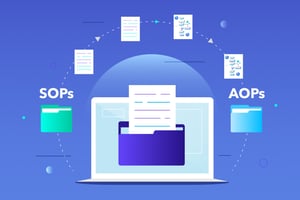
While working with our Enterprise customers, I've noticed that there's an assumption baked into their AI strategies that I predict will cause most agentic implementations to fail in the coming years. Most organizations I speak to believe that their current Standard Operating Procedures (SOPs) and existing process documentation paired with interviews, are a strong foundation upon which they can build successful AI agents.
It's clear to me that this will be an error for many enterprises across industry verticals. The only way to correct it is to build what I call the Agentic operating procedure (AOP), a living representation of every bit of work being done in an organization that agents can use to successfully automate tasks.
Every large organization has them: thick binders, SharePoint folders, or wiki pages describing how a process should run. The claims intake procedure. The underwriting workflow. The customer onboarding checklist. These are Standard Operating Procedures, and for decades, they've served as the official record of how work gets done.
The problem is that SOPs describe an ideal, a snapshot of how someone, at some point in time, imagined a process would look. They don't capture how technology has changed since then. They don't reflect the judgment calls operators make when a system doesn't have the right field, so they open a separate spreadsheet to do a calculation before switching back. They don't document the three different ways a team of 125 people might handle the same claim or loan on the same day.
SOPs are what organizations want their processes to look like. What actually happens on the desktop is something else entirely.
This gap has always existed, and businesses have learned to live with it. But in the age of AI agents, that gap becomes a liability.
When a company hands an SOP to a human employee, something important happens: the employee fills in the blanks. They ask colleagues questions. They adapt. They develop intuition. Over time, they build a mental model of the process that goes far beyond what any document could describe.
AI agents can't do that, not without the right foundation. An agent handed a static SOP is, in a sense, a new hire who's only ever read the manual and never watched someone actually do the job. The moment it encounters an exception (a variation, an edge case, an unexpected system state), it's lost.
No CIO or senior stakeholder should accept that risk, especially in high-stakes business processes like insurance claims, financial compliance, or healthcare prior authorizations. The tolerance for agent errors in these environments is essentially zero. And yet, most enterprises are charging ahead, attempting to train agents on documentation that was never accurate from the start.
At SkanAI, we've been watching this problem take shape across enterprise after enterprise. Over the last several months, we've become increasingly convinced that traditional rule-based approaches built on existing policies and documents will not be sufficient to meet the bar that enterprise AI demands. That conviction led us to a different way of thinking about what agents actually need, and what we're now calling the Agent Operating Procedure (AOP).
An AOP is not an updated SOP. It's not a better-formatted policy document or a more detailed wiki entry. It's something fundamentally different: a living, breathing representation of every step, every process variation, the intent behind every action, and every decision made by the operators who actually live and breathe these processes, captured where all the work happens, on the desktop.
I find it helps to think of the difference this way: An SOP is a static rulebook. An AOP is a living playbook. A rulebook tells you what should happen. A playbook shows you how the game is actually played.
The work of building an AOP starts with observation. Skan AI's platform deploys a lightweight sensor that watches how work actually happens across every application an operator touches (legacy systems, web apps, Excel, email, and everything in between). It provides a complete, continuous, privacy-compliant view of real operational behavior.
Skan then constructs what we call the Work Graph, a structured, queryable process model that captures both what operators do, and - this is key - why. It records the attributes (what data is used), the screens (where work happens), the steps (what actions are taken), the business rules (why decisions are made), and the users, both human and, increasingly, AI agents.
Let's talk through this real-world example from an insurance company. A Group Disability claims team manages case eligibility and case "mark-up." On paper, this is a single, well-defined process. In reality, across 125 operators, Skan observed 365 distinct process variations for the same workflow, a roughly 10-minute, 40-action task that no SOP had ever fully described. Each of those variations represents real operational knowledge. Some reflect workarounds for system limitations. Some reflect the habits of top performers. All of it is signal that a well-built agent needs to operate reliably.
One aspect of work that an AOP captures that a traditional SOP never could is intent. Specifically, the reasoning behind why an operator moves from one system to another, or takes an action that looks inefficient on the surface but makes perfect sense in context.
For example, an operator is working in a claims system, then opens Excel to run a calculation, then returns to the original tool to enter a result. From the outside, that looks like a workaround. And it is, but why? Sometimes the intent is that the source system lacks the ability to perform that calculation. An agent that doesn't understand that intent will either replicate the workaround blindly, skip the step, or fail entirely when it encounters the same scenario.
An AOP brings that intent to the surface. It provides agents with the context behind every action, not just the action itself. And it represents the full picture of the organization and the tools they use, rather than a single operator's experience.
Perhaps the most important distinction between an SOP and an AOP is what happens over time.
SOPs are static. They're written once, updated occasionally, and drift further from operational reality with every technology change, process improvement, and team turnover. By the time anyone thinks to update them, the gap between document and reality has grown too wide to bridge easily.
An AOP is continuously refreshed. Because it's built from live observation rather than human documentation, it evolves as the business evolves. When a new system is introduced, the AOP reflects the new workflow. When operators adapt their behavior, that adaptation is captured. When Skan AI's agents execute work, that execution generates new data that feeds back into the process model, improving both the intelligence and the agents themselves.
This continuous feedback loop of observing, distilling, acting,and improving) is what makes agentic AI reliable at enterprise scale.
For anyone who's watched the shift from traditional search engine optimization (SEO) to answer engine optimization (AEO) in the era of generative AI, the parallel here is similar. AEO didn't replace SEO overnight, but it fundamentally changed what it meant to be "found," and the companies that understood that early adapted their content strategies accordingly.
The shift from SOP to AOP is the same kind of transition for enterprise operations. It's not that procedures become worthless. It's that the standard of what an AI agent needs to perform reliably is categorically different from what a human needed to read a policy document.
The companies that recognize this shift early, and invest in building the operational foundation that agents actually need, will be the ones whose AI investments compound over time. The others will wonder why their agents keep failing on exceptions.
Skan AI is here for every step of this journey. Whether you're at the beginning, asking "where should AI even be applied across my operations?", or further along, asking "where do I source the context my agents need to work reliably?", our platform is built to answer those questions from observed operational reality, not assumptions.
We surface the on-the-ground reality of how your business actually runs. We build the Work Graph that makes your processes legible to agents. And we help you construct Agent Operating Procedures that give your AI the context, the intent, and the institutional knowledge it needs to perform, not just in demos, but in production.
The SOP had a good run. But the agentic enterprise runs on something better.
Aman Rangrass is the Chief Revenue Officer at Skan AI. Skan AI's process intelligence platform helps enterprises observe, understand, and automate how work actually happens, powering the most reliable foundation for enterprise AI agents.

Explore how agent operating procedures power agentic AI for P&C insurance, covering claims automation, underwriting triage, and fraud detection. See Skan AI in action.
Learn how to create accurate, up-to-date SOPs using process intelligence. Build standard operating procedures that reflect actual work—not outdated guesswork.
Enterprise AI fails to deliver EBIT impact at scale. An agentic AI operating model defines how autonomous agents integrate into enterprise operations and governance to deliver measurable outcomes.
Unlock your transformation potential. Subscribe for expert tips and industry news.