Whitepapers & eBooks
Sep 2, 2025
.png?fit=crop&width=48&height=48&name=Favicon%20Primary%202%20(2).png)

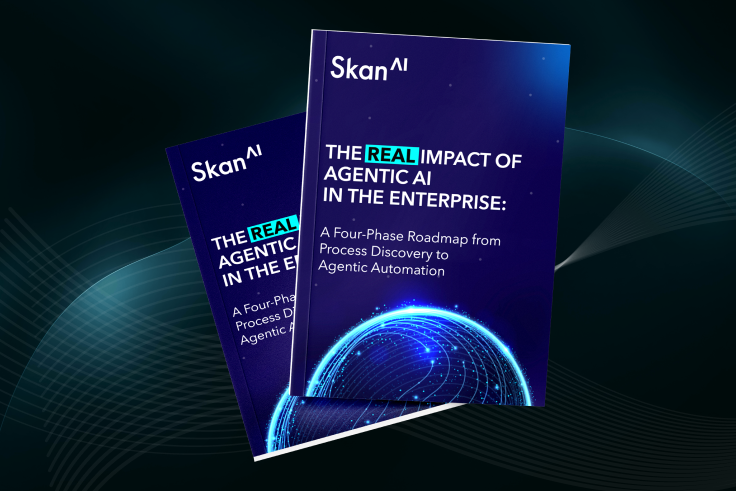
You're not alone. Across healthcare, insurance, and technology, 80% of enterprise AI projects never scale past proof of concept. The technology isn't the bottleneck. The foundation is. Organizations achieving $10M–$30M+ in annual savings share one defining characteristic: they started with how work actually happens—not how documentation says it should.
This whitepaper cuts through the noise. It shows where agentic AI is generating real enterprise results, why most initiatives stall before they scale, and what separates the 20% who move from motion to momentum. Every data point comes from real deployments—not vendor projections.
The numbers below are not outliers. They come from a repeatable pattern documented across healthcare, insurance, and high-tech deployments:
Most enterprise AI starts in the wrong place: process documentation. Flowcharts, SOPs, and system architecture diagrams describe how work is supposed to happen. In practice, that rarely matches how work actually flows. When AI is trained on documented processes, it learns a fiction. It automates that fiction. That's why bots break on the edge cases that make up most of actual work.
Process intelligence is the continuous observation of how work actually happens across every application, team, and workflow—without relying on system logs or manual interviews. It's the difference between a map and a GPS. A map shows the road as designed. A GPS shows real-time conditions. Every organization achieving $15M+ in OPEX savings solved this first.
This first-party operational data becomes the training foundation that Large Action Models need to understand—and optimize—your specific workflows. Generic AI can't do this. Your AI needs to be trained on how your organization actually works.
The path from AI experiment to AI ROI follows a proven sequence. The whitepaper maps a four-phase roadmap—starting with process discovery to build your digital twin and surface inefficiencies, moving into optimization to eliminate waste before it gets automated, then deploying intelligent automation for high-impact use cases, and finally evolving to full agentic automation where process agents handle complete workflows autonomously. Organizations that follow this sequence consistently achieve 50–75% productivity improvement in targeted processes within 12 months—with $10M+ in annual savings for enterprise deployments.
Cut claims processing time by 40% and boost productivity 30%. Discover how Fortune 100 insurers use AI-driven process intelligence to dominate.
Cut processing times 30-50% and save millions. Learn how banks use process intelligence to transform underwriting and prepare for agentic AI.
Transform AML operations with process intelligence. Learn how leading banks avoid $3B+ penalties through automated compliance monitoring solutions.
Unlock your transformation potential. Subscribe for expert tips and industry news.