ChatGPT
 Perplexity
 Grok
Grok
 Gemini
 Claude
Blogs
Apr 30, 2025

TL;DR: Skan AI clients across insurance, banking, and healthcare commonly identify $10M to $28M in annual savings and 30 to 40% cycle time reductions through process intelligence (The Competitive Edge in Enterprise AI, Skan AI Q1 2026). Most programs stall not because of the technology, but because organizations lack complete visibility into how work flows. Process intelligence is the real-time capture and analysis of how work flows across every application, team, and system in an enterprise. Skan AI's process intelligence fixes this by observing every human-computer interaction at scale, surfacing the opportunities traditional methods miss, and delivering a four-phase framework that turns automation into a measurable, self-funding improvement cycle.
.webp?width=655&height=365&name=How%20to%20Optimize%20Enterprise%20Automation%20with%20AI%20A%204-Phase%20Framework%20(2).webp)
This framework is designed for four types of enterprise automation leaders: those building a new automation program, those scaling an existing one, those defending ROI to leadership, and those preparing for agentic AI deployment.
Automation programs stall because organizations do not have complete visibility into how their processes run. Without that data, prioritization is based on guesswork, not evidence.
Legacy process discovery methods compound this problem. Traditional enterprise environments are built for operational stability, not automation discovery. This leaves three critical blind spots:
The result is automation leaders targeting the wrong processes, spending months on low-impact initiatives, and struggling to justify further investment to the business.
Skan AI's process intelligence platform captures digital workflows across every application in real time, including the manual steps and exception paths that traditional methods miss entirely.
There are four sequential phases: Identify, Prioritize, Automate and Measure, and Improve. Automation programs that move past pilot stage consistently share one design element: real process data at every prioritization decision
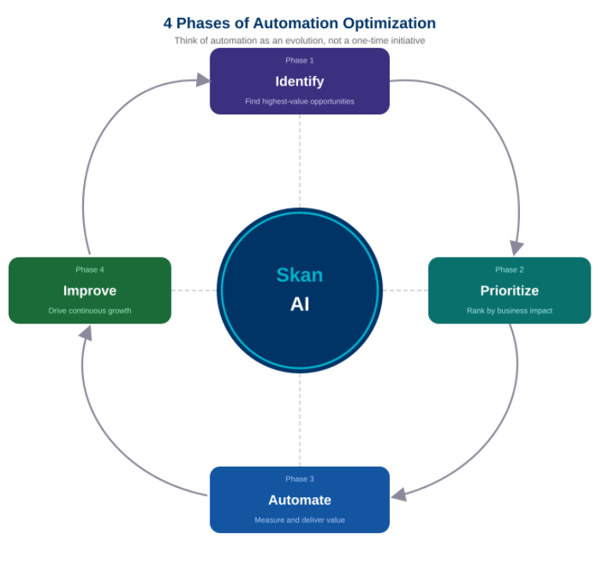
The 4-phase automation optimization framework. Each iteration's ROI fuels the next cycle.
Phase 1: How Do You Identify the Right Automation Opportunities?
You identify the right automation opportunities by capturing how work actually flows across every application, team, and system in real time.
Skan AI maps digital workflows in real time, including the manual steps, workarounds, and exception paths that traditional methods miss. What this surfaces that legacy methods cannot:
Phase 2: How Do You Prioritize Automation for Maximum Business Impact?
You prioritize automation by ranking processes against business value, not ease of implementation. The highest ROI hides in the hardest workflows.
Legacy prioritization is driven by stakeholder politics and technical familiarity. A CFO champions automating expense reports because it affects their daily workflow. Meanwhile, procurement processes worth millions go untouched because they span legacy systems no one wants to tackle.
Skan AI replaces subjective scoring with multi-dimensional value analysis across three lenses:
Phase 3: How Do You Automate and Measure Results Effectively?
You automate and measure effectively by shipping the first working component within 30 days and connecting each increment directly to a business outcome, not a technical metric.
Traditional automation projects run on waterfall timelines: months of requirements, months of development, months of testing. By the time a solution is deployed, the business has moved on. A modern agile approach delivers differently:
Phase 4: How Do You Drive Continuous Automation Improvement?
Continuous improvement is driven by connecting automation performance to business outcomes in real time and reprioritizing automatically as conditions change.
Legacy measurement pulls data from individual automation tools in isolation. Finance reports that invoice processing is 30% faster. Customer service simultaneously sees complaint volumes rise because automation errors are creating downstream failures. The two numbers never connect.
Skan AI gives every team a single view of automation performance that continuously tracks:
What Is the Future of Enterprise Automation?
The future of enterprise automation is agentic AI grounded in process intelligence. Production deployments in regulated enterprises are already shifting how operations teams think about automation entirely. The question is no longer what to automate. It is which decisions are safe to delegate, and what operational context agents need to make those decisions reliably.
That cancellation risk is not a technology problem. It is a process visibility problem. Agentic AI agents require a deep, accurate understanding of how enterprise work actually flows before they can make autonomous decisions safely. Organizations that lack that foundation are deploying agents into a black box. For a deeper look, read How to Build an Agentic AI Strategy With Process Intelligence.
Skan AI provides the data-first process intelligence layer that gives agentic AI the context it needs to operate reliably. Each phase of the 4-phase framework builds that layer: richer process data, more accurate prioritization, tighter feedback loops, and measurement connected directly to business outcomes.
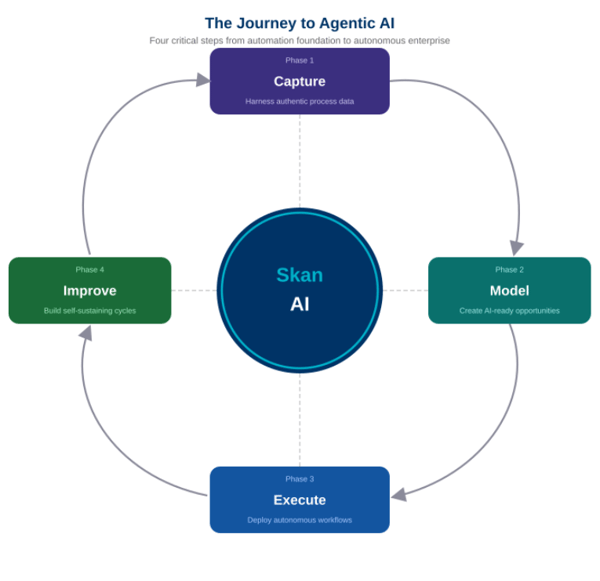
The Skan AI agentic AI framework: four steps from data capture to self-improving enterprise.
The enterprises that lead automation at scale are not the ones with the most bots deployed. They are the ones that built the observational foundation first, and used it to make every subsequent investment count. Skan AI gives transformation leaders the complete picture of how work actually happens, so every initiative is grounded in data, not assumptions.