 ChatGPT
 Perplexity
 Grok
Grok
 Gemini
 Claude
Blogs
Apr 3, 2025
.png?fit=crop&width=48&height=48&name=Favicon%20Primary%202%20(2).png)
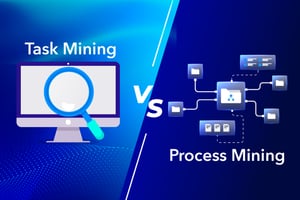
Task mining and process mining both promise visibility into business operations—but they're observing completely different realities. Task mining captures what happens at individual desks. Process mining reveals how work flows across your enterprise. Treating them as interchangeable alternatives is why most process intelligence initiatives fail to drive real change.
Why can't enterprises see how work actually gets done?
Digital transformation depends on understanding operational reality, not wishful thinking about how processes "should" work. Yet most organizations operate blind—making automation decisions without knowing what people actually do, and optimizing processes they haven't properly mapped.
This visibility gap has driven adoption of two distinct discovery approaches: task mining and process mining. Both capture process data. Both promise operational insights. Both claim to enable transformation.
But they're answering fundamentally different questions.
Organizations confusing these approaches waste millions on tools that generate data instead of decisions. Those that understand which discovery method solves which problem build process intelligence that actually changes outcomes.
Task mining records reality at the desktop level to grab screenshots of applications as the user navigates their work.
This granular capture reveals the big gap between how IT thinks employees use software versus how they actually use it. This is where manual steps devour hours and why people build elaborate workarounds.
Repetitive click sequences emerge with perfect clarity. Copy-paste routines between systems. Manual data transfers that scream for RPA. Task mining doesn't just identify automation candidates—it documents exactly how humans currently execute them.
Task mining can offer some visibility into which applications people spend their time in. However, this is typically limited to common applications as task mining struggles to understand enterprise legacy homegrown applications or mainframes (yes, they are still in use)
Not where managers think effort goes. Where it actually disappears. Task mining timestamps activity, creating records of how work time gets allocated—or wasted.
Task mining's strength is its fatal limitation for enterprise process intelligence.
Customer onboarding doesn't live in any single person's workspace. It spans sales reps, operations specialists, compliance reviewers, implementation teams. It touches CRM, ERP, contract systems, provisioning platforms. It involves automated workflows, manual approvals, external integrations, exception handling.
Task mining captures what each person does individually. It misses the process that connects those activities into business outcomes. It's best for small teams with simple, single-person processes.
Work moving between people is invisible to typical task mining, given its narrow focus on single users. Yet these transitions are where most breakdowns occur.
The "Why This Way?" Gap
Task mining shows what someone did. It provides minimal insight into why that specific sequence was necessary versus alternative paths for different case types.
Fragmented Performance Measurement
You'll know how long individual activities took. You won't know end-to-end cycle time, completion rates, or the cumulative impact of delays across the full process.
Process mining takes a radically different approach. Instead of watching desktops, it analyzes event logs from business systems to reconstruct how processes actually execute end-to-end.
Every enterprise application broadcasts its activity: case created, approval requested, document generated, status changed. Process mining assembles these signals across systems to reveal the complete flow from initiation to completion.
The full lifecycle. Mortgage applications flowing through origination, underwriting, compliance, closing. Insurance claims moving from first notice through investigation, adjudication, payment.
This holistic view exposes patterns, variations, and bottlenecks that only emerge when analyzing complete workflows—not isolated fragments.
Not task duration. Process duration. Where delays accumulate. Which variations kill completion rates. What actually drives business outcomes—faster resolution, higher throughput, better quality.
How processes actually execute versus how they're supposed to execute. Where operations deviate from design. Where exceptions became standard practice. Where compliance risks hide in plain sight.
For regulated industries, this is evidence—not assumptions—about whether operations follow required procedures.
Enterprise-level visibility comes with tradeoffs.
Event logs only capture what systems record. Phone calls? Physical documents? Unstructured decisions? Invisible to process mining.
If significant work happens outside enterprise applications, your discovery results stay incomplete. You see what systems logged, not necessarily what people did.
Additionally, process mining shows that a step took 30 minutes—not whether that time involved focused work or constant application crashes and user frustration.
The organizations extracting real value from process intelligence recognize a fundamental truth: task mining and process mining aren't competitors. They're complementary lenses.
Task mining reveals the mechanics of how people work. Process mining reveals how that work connects to business outcomes.
Together, they create complete operational understanding.
Skan AI delivers both perspectives through unified process intelligence. We observe individual user activities for task-level detail while simultaneously reconstructing end-to-end process flows across enterprise systems.
This integrated approach provides the full context for informed decisions. You see both what people do and how those activities drive business processes. You understand where task-level inefficiency compounds into process-level failure. You identify improvements that fix both individual work and enterprise workflows.
How can you optimize what you can't fully see?
The answer: you can't.
As enterprises advance their process intelligence capabilities, success doesn't come from choosing between discovery methods. It comes from capturing the complete operational picture—from individual tasks to enterprise workflows.
The process intelligence strategies that actually drive transformation with agentic AI recognize that task mining and process mining solve different problems, and comprehensive discovery requires both perspectives.
Are you discovering processes or just generating data?
Learn what task mining is, how it compares to process mining, and why Skan AI's process automation platform delivers a more complete view of enterprise work. Read the guide.
Most process mining tools miss the desktop-level work where your biggest efficiency gains are hiding. Here are five specific signs yours is one of them.
Explore the process mining evolution from log-based analysis to AI-powered process intelligence. See why next-generation process mining platforms are built differently. Read now.
Unlock your transformation potential. Subscribe for expert tips and industry news.